
Introduction
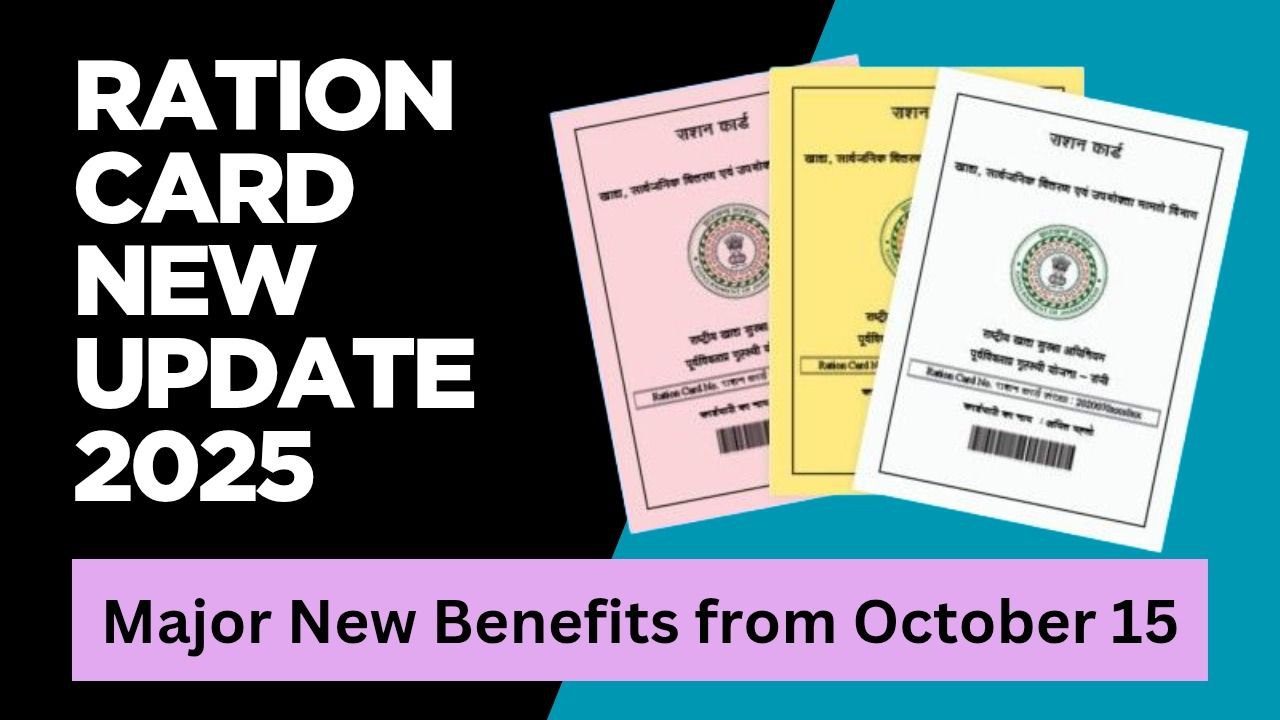
Ration Card New Update 2025: 8 Major New Benefits from October 15: Public Distribution System (PDS) and ration cards have long been crucial for ensuring food security in India. As the government continually updates policies to target benefits more effectively and eliminate misuse, 2025 is seeing significant reforms. From 15 October 2025, eight new benefits (or changes) are slated to come into effect for ration card holders. This article explains each of them, who will benefit, and what you should do to stay eligible.
Background and Need for Reform: Ration Card New Update 2025
- Under the National Food Security Act (NFSA), eligible households receive subsidized food grains via PDS.
- However, over time, leakages, duplicate cards, ineligible recipients, and lack of transparency have hampered effectiveness.
- To address these, the central and state governments are pushing stricter verification, digitization, and benefit restructuring.
- Recently, the government has also used cross-database matching (tax records, vehicle ownership, etc.) to flag ineligible ration card holders.
- Moreover, mandatory e-KYC (Aadhaar linking) has been a condition to maintain benefits. The deadline for e-KYC was March 31, 2025.
8 New Benefits from 15 October 2025: Ration Card New Update 2025
| Benefit / Change | Description and Impact |
|---|---|
| Automatic de-duplication and removal of ineligible cards | Cards flagged via cross-checking with tax, vehicle, and corporate databases will be reviewed and, if necessary, deactivated to avoid misuse. |
| Strict e-KYC / Aadhaar linkage enforcement | All ration cards must complete e-KYC by the deadline (already mandated by March 31, 2025). If not linked, subsidies may be suspended. |
| Portability and inter-state usability improvements (“One Nation One Ration Card” enhancements) | Beneficiaries will more easily claim rations even in different states, improving mobility benefits. (This is an ongoing policy that is likely to be reinforced in October.) |
| Doorstep / home delivery for vulnerable groups | In some states, for senior citizens, differently-abled, or immobile persons, ration will be delivered at home. For example, Tamil Nadu launched a scheme for doorstep delivery ahead of festivals. |
| Smart / QR-enabled ration cards & grievance redressal via QR | Some states are issuing smart ration cards with QR codes, enabling complaint registration at the shop itself. |
| More frequent or bulk dispensing of ration | Some states plan to issue multi-month rations (e.g. three months’ supply at once) to reduce visit frequency. |
| Digital payments and POS / UPI in ration shops | Ration shops may start accepting digital payments (UPI / POS) to reduce cash leakage, improve tracking, and auditability. |
| Better transparency, online tracking & dashboards | Enhanced public dashboards, tracking tools, and real-time monitoring of distribution on NFSA / PDS portals. The NFSA portal already provides facility for registration and claim tracking. |
Who Will Benefit and Who Could Lose Out: Ration Card New Update 2025
Beneficiaries
- Poor and vulnerable households who truly qualify under NFSA / state PDS schemes
- Elderly, disabled, or immobile persons who get home delivery or easier access
- Migrant families or people moving between states (via portability)
- Honest cardholders under pressure from misuse in system
Risks/Loss of Benefits
- Those who fail to complete e-KYC or link Aadhaar by required deadlines
- Cardholders who are flagged as ineligible (for instance, higher taxpayers, vehicle owners, corporate directors) and not able to justify their status
- Fraudulent or duplicate cards
- People who are unaware or fail to update/ upgrade their cards under new requirement regimes
Steps to Take (What You Should Do): Ration Card New Update 2025
- Check Aadhaar linkage / e-KYC status: Visit your state’s PDS / ration card portal and confirm your card is Aadhaar-linked and e-KYC is completed.
- Update / correct card details: Ensure all names, addresses, family members are correct and recent. If needed, apply for correction, add or remove names.
- Monitor notices / messages from state govt: Watch for SMS / letter / local announcements about verification drives or whether your card is flagged.
- Retain proof / documentation: If your card is flagged as ineligible, you may need to prove that your income / assets are within norms. Keep income certificate, vehicle ownership documents, etc.
- Check portability / inter-state policy: If you move or travel to another state, learn about the PDS portability rules in that state.
- Use digital / app tools: Use state PDS apps or NFSA dashboard online tools to track your ration status, complaints, etc.
- Participate in grievance / feedback system: Use QR complaint codes at ration shops (if available) or official grievance mechanisms to report issues.
- Keep eye on state-specific notifications: Because food & civil supplies is a state subject, exact benefits, schedules, and rules may vary by state.
Caveats and State-wise Variations: Ration Card New Update 2025
- The central guidelines establish a framework, but implementation details (benefit amounts, eligibility thresholds, provisions) vary by state.
- Some states may delay or phase in certain benefits (home delivery, smart cards, etc.).
- The new “benefits” listed above are derived from public notices, media reports, and government portals; always refer to your state’s food and supplies department website for the final version.
- Some items (like three-month issuance or QR-enabled cards) may exist already in pilot in some states.
- In states where PDS is weaker or digitally constrained, rollout might be slower.
NFSA Portal (official): Click Here
One Nation One Ration Card (myScheme portal): Click Here
Ration Card / State-wise Portals (NFSA portal): Click Here
One Nation One Ration Card (UMANG portal): Click Here
Final Thought: Ration Card New Update 2025
The October 15, 2025 reforms for ration cards represent a significant push toward better targeting, transparency, and modernization of India’s Public Distribution System. While the eight new benefits listed above will empower genuine beneficiaries, success depends on effective implementation, citizen awareness, and timely compliance (e.g. e-KYC, data updating).
Read Also: DA Hike and Pay Merger 2025: Basic Pay Reset and New Salary Rules Explained